What Is Linen Fabric: Properties, How It Is Made and Where
Linen is a natural textile made from the bast fibers of the flax plant. It is prized for a combination of practical and aesthetic qualities: high tensile strength, good moisture handling, a cool hand on the skin, and a refined surface luster that improves with age.

Linen garments and home textiles remain popular because they combine durability with a distinct natural appearance. In the sections that follow, you will find a full technical and practical account of linen: how the fiber is grown and processed, how to tell quality, how linen is used today, relevant certifications, and sensible guidance for buying of linen fabric products.
What Is Linen Fabric?
Linen fabric is the woven textile made from fibers harvested from the stem of the flax plant. Unlike cotton, which comes from seed hair, flax fibers are long and structural. These fibers are found in bundles in the plant stem and once separated and processed, they yield yarns that are notably stronger than many other vegetable fibers. Linen is recognizable by its crisp but soft handle, subtle sheen, and characteristic small slubs in the yarn that give it a natural, irregular texture.
Key material properties and why they matter
Strength and longevity: Flax fibers have high tensile strength. A linen fabric product that is properly made and cared for will often outlast similar items made from other natural fibers.
Moisture management: Linen fabric absorbs moisture efficiently and releases it quickly. That makes linen feel cool next to the skin and helps bedding and towels dry faster.
Thermal comfort: Linen fabric is breathable and conducts heat away from the body. It performs well in warm and humid climates, and it also carries a natural insulating quality in cooler conditions when layered.
Surface appearance: Linen develops a soft patina with use and washing. It does wrinkle easily, but many consider that part of the fabric’s relaxed aesthetic.
Low pilling and abrasion resistance: Linen resists pilling and stands up well to abrasion, which contributes to its long service life.
These combined properties make linen attractive across apparel, home textiles and a growing set of technical uses.
History of Linen
Linen is one of the oldest cultivated textiles in human history. Archaeological finds show evidence of flax use in the Neolithic period and linen cloth appears throughout ancient records from Egypt, Mesopotamia and the Indus valley. In Egypt, finely woven linen was associated with ritual and high status.
In Europe, linen production became a cornerstone rural craft from the medieval period through early industrialization. Linen’s long history includes household manufacture, guild systems, and regional centers where climate and soil favored high quality flax.
Important historical notes
Ancient use: Linen was used both as a daily textile and for ceremonial purposes such as the wrapping of mummies. The fabric’s durability and insect resistance made it valuable.
Medieval and early modern Europe: Flax cultivation and linen weaving were important in northern Europe, particularly in river valleys where retting in slow moving water was possible.
Industrial changes: Cotton and later synthetic fibers displaced linen in many mass markets because of cost and ease of processing. At the same time quality linen remained important for high end clothing, linens and technical applications.
Modern revival: In recent decades linen has seen renewed demand driven by sustainability concerns, interest in natural fibers, and high end fashion and home markets.
Understanding the history helps explain why linen today is often positioned as a premium natural textile with craft and origin narratives attached.
Linen Today
Today linen is both a traditional craft and a modern commercial fiber. Production is concentrated where climate and agronomy favor high quality flax. Europe, particularly parts of France, Belgium and the Netherlands, supplies much of the world’s premium flax. Other countries including parts of Eastern Europe, China and some regions of South Asia also produce linen and flax products.
Contemporary uses and market trends
Fashion: Linen is a staple in warm weather collections. Designers use linen for shirts, dresses, suits and lightweight tailoring where breathability and drape matter.
Home textiles: Linen is common in bed sheets, pillowcases, table linens and curtains where its moisture handling and tactile appeal add value.
Technical and industrial uses: Flax fibers appear in composite materials, insulation, and specialty papers where natural strength and biodegradability are advantages.
Sustainability positioning: Brands emphasize linen as plant based and biodegradable. Responsible flax cultivation and low chemical inputs are important selling points for environmentally minded consumers.
Premiumization: Consumers are willing to pay more for linen that includes traceability, European origin, organic credentials or artisan processing.
Commercial linen therefore sits at the intersection of craft, technical performance and environmental messaging.
How Is Linen Fabric Made?
1. Planting
Flax is sown relatively densely so stalks grow tall and slender. Sowing time and seed variety determine fiber length and fineness. Soil quality and crop rotation practices influence plant health and fiber cleanliness. Flax prefers a temperate climate with regular rainfall rather than irrigation dependent environments.
What affects quality at this stage
Seed variety: Different cultivars yield different fiber lengths and fineness.
Sowing density: Denser sowing encourages fewer branches and longer fibers.
Soil care: Minimal chemical input and good rotation help produce clean fibers that require less chemical retting.
2. Growth
During its roughly 90 to 120 day cycle the plant develops stems and flowers. The fiber matures from the inside of the stem, and stress during growth can shorten fiber length or damage the bast.
Quality controls during growth
Harvest timing: Harvest too early and fibers are immature. Harvest too late and fibers are coarse.
Crop management: Reduced pesticide use and controlled fertilization are common in higher quality production.
3. Harvesting
High quality linen depends on pulling the whole plant from the ground rather than cutting. Pulling preserves fiber length and minimizes damage to the bast bundle. Historically this was done by hand; modern systems may use specialized machinery that still extracts stems intact.
Why pulling matters
Preserves long fibers: Longer fibers yield stronger, smoother yarns.
Reduces short fiber content: Short fibers reduce spinning efficiency and strength.
4. Fiber separation (retting)
Retting is the process that loosens the outer stem material so fibers can be separated. There are three commonly used retting methods:
Dew retting: Stems are spread on fields and allow natural microflora and moisture to break down the pectin that binds fibers. Dew retting is low tech and produces a soft, high quality fiber where climate supports it.
Water retting: Stems are immersed in tanks or controlled ponds. Water retting works faster and can give very uniform results but requires water management and effluent control to avoid pollution.
Enzymatic retting: Modern approaches use controlled enzyme baths to separate fibers with reduced environmental impact and more consistent results.
Each method influences the fiber’s color, strength and fineness. Farmers and processors choose a method based on climate, production scale and sustainability objectives.
5. Breaking and scutching
After retting the woody portions are broken and removed. Breaking crushes the stalk to shatter the hard outer tissues. Scutching removes the broken wood fragments by scraping or beating. The objective is to free the long flax fibers with minimal fiber breakage.
6. Combing
Combing aligns fibers and separates long line fibers from short tow fibers. Multiple passes through combs produce a ribbon of long parallel fibers for spinning fine yarns. Shorter fibers are collected as tow and can be used for coarser yarns, twine or technical fibers.
Why this step is critical
It determines yarn smoothness and luster.
Longer, well aligned fibers lead to higher strength and finer count yarns.
7. Spinning
Spinning converts the aligned fibers into yarn. There are two principal spinning approaches for flax:
Wet spinning: Fine linen yarns are often produced with wet spinning. Fibers are spun in a moist environment which helps produce a smoother, more even yarn suitable for fine apparel.
Dry spinning: Coarser yarns and tow are often spun by dry methods for heavier linens and home textiles.
Spinning parameters such as twist per inch and drafting influence final yarn strength, hairiness, and handle. Skilled spinning can reduce slub while retaining linen’s natural character.
8. Warping, sizing and loom preparation
Yarn is wound onto beams for the warp and prepared for the loom. For woven linen, warp preparation and sizing can protect fibers during weaving. Sizing applies a protective coating to warp yarns in some production lines to reduce breakage on high speed looms.
9. Weaving and knitting
Linen is most commonly woven into plain, twill or damask structures. Weave choice affects opacity, drape and strength. Linen can also be knitted into jersey structures for softer garments.
Practical weaving notes
Plain weave yields strong, open structure for general use.
Twill gives improved drape and subtle surface interest.
Damask uses patterning to produce decorative home textiles.
10. Finishing and washing
After weaving the fabric is scoured to remove residual pectins and retting residues. Finishes may include mechanical softening, stone washing, enzyme softening, bleaching for white linen, and dyeing. Importantly, finishing shapes final hand, drape and color fastness.
Environmental and quality considerations in finishing
Use of mild processes and controlled wastewater treatment is key for sustainable linen.
Minimal finishing can be a selling point for consumers who prefer natural handle and color.
How Is Linen Fabric Used?
1. Apparel
Lightweight shirts and blouses: Look for fine yarns and plain weave for a soft, breathable shirt.
Dresses and trousers: Medium weight linens with refined finishing give better drape and reduced transparency. Tailors use interfacing and specific cuts when constructing linen suits to control wrinkle and create structure.
Outerwear and layering: Linen can be blended with other fibers to add resilience and reduce creasing while preserving a natural hand.
2. Home textiles
Bed linen: High quality sheeting linen is woven closely and finished for a soft hand. Linen sheets are breathable and become softer with each wash. They are often marketed by weight rather than thread count.
Towels and kitchen linens: Loosely woven linen is favored for tea towels because of its absorbency and speed of drying.
Drapery and upholstery: Damask and heavier linens are used for decorative table linens, curtains and some upholstery where a natural look is desired.
3. Technical and industrial uses
Composite reinforcement: Flax fibers are used in natural fiber composites for automotive and building applications where reduced weight and biodegradability are advantages.
Specialty papers and insulation: Flax fibers provide a natural option for niche industrial products.
What Different Types of Linen Fabric Are There?
The term linen covers a spectrum of fabric constructions and finishes. Below I expand the four categories you flagged and add guidance on how to recognize them.
1. Damask linen
Damask linen features reversible patterns created through weave structure. It is often used for table linens and decor where pattern clarity and sheen are important. Damask requires tighter control of yarn tension and finishing to present the pattern crisply.
Look for woven pattern visible on both faces of the fabric.
Typically medium to heavy weight with a smooth finish.
2. Plain-woven linen
Plain woven linen is the most common and versatile. It has a balanced interlacement of warp and weft. Plain weave can range from very fine for shirts to coarse for sacks.
Checkerboard like appearance on close inspection.
Stable, less drapey than twill, good strength.
3. Loosely-woven linen
Loosely-woven linen has open interlacements. It is breathable and soft to the touch. This structure suits towels, shawls and garments intended to be cool and quick to dry.
Visible openness in the weave; lighter weight feel.
More pronounced texture and possibly more slubs.
4. Sheeting linen
Sheeting linen is finished for a smooth surface and consistent hand. It is generally tighter woven and finished to reduce initial stiffness. Used for bedsheets and fine summer garments.
Smooth surface, less visible slubs, consistent color and ply.
Often mercerization is not applied, but quality finishing reduces harshness.
Beyond these four, linen appears in twills, satin weaves, blends, and specialty selvedge fabrics. Each weave and finishing choice shifts the balance between durability, drape and aesthetic.
Linen Fabric Certifications Available
Certifications increase buyer confidence by documenting production protocols, chemical inputs and supply chain traceability.
Below are the common and relevant certifications you should look for when sourcing or buying linen.
GOTS, the Global Organic Textile Standard: GOTS covers the entire textile supply chain from fiber to finished product. For linen, GOTS ensures organic flax farming, restricted chemical processing, and socially responsible manufacturing practices. Certification requires auditing and chain of custody documentation.
OEKO-TEX Standard 100: This standard tests finished textiles for harmful substances. A certified label confirms that final products are free from listed restricted chemicals and are safe for skin contact.
Master of Linen: This label certifies flax and linen produced entirely in Europe following strict quality and traceability rules. It is often associated with premium European linen brands.
European Flax certification and national labels: Several regional schemes verify origin and processing standards that are particularly important for buyers seeking European origin linen.
FSC and other related chain of custody programs. Where linen products include wood based components or composite elements, additional certifications may apply.
Why certifications matter
Consumer safety: They reduce risk of chemical exposure in contact textiles.
Environmental assurance: Certified linen often means reduced environmental footprint in farming and processing.
Market access: Many retailers require certification for sourcing.
When evaluating certification claims, check the certifier’s database or request a certificate number.
How to Assess Linen Quality and What to Look For When Buying
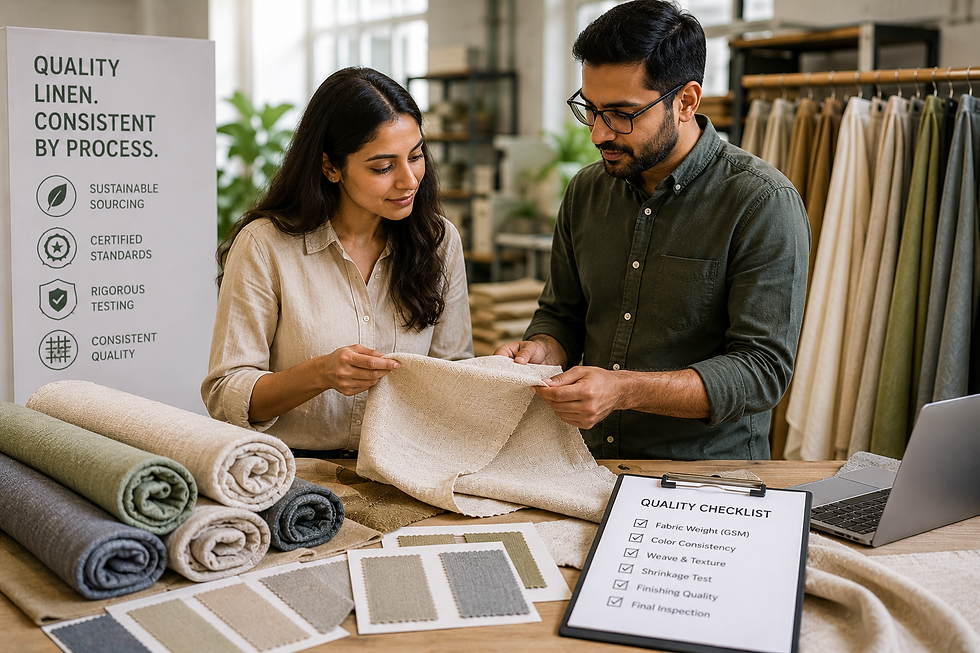
Quality assessment involves looking at raw material attributes, yarn and fabric construction, finishing and documented origin. Below are practical checkpoints:
Fiber length and evenness: Longer, straighter fibers usually correspond with stronger, smoother yarns.
Yarn count and twist: Fine yarn counts with controlled twist produce lighter, softer fabrics. Coarser counts give more weight and durability.
Weave tightness and finish: Sheets and apparel that require opacity and smoothness use tighter weaves and softer finishing. Towels and kitchen linens use looser weaves for absorbency.
Slub character: Natural small slubs are normal in linen. Excessive thick slubs can indicate poor combing or low grade tow.
Color and whitening: Natural linen has a creamy tint; bleaching reduces color but may also reduce strength if overdone. Prefer minimal, controlled bleaching.
Certification and traceability: Ask vendors for GOTS, Master of Linen or OEKO-TEX documentation if sustainability or chemical safety is important.
Weight and hand: Evaluate the fabric by touch and drape for the intended end use.
Supplier reputation and sample testing. For large buys, request mill certificates, samples and small production runs to validate quality.
Conclusion
Linen is a versatile, highly functional natural textile with deep historical roots and growing modern relevance. Its performance properties make it an excellent choice for warm weather clothing, long wearing home textiles and emerging technical uses.
Key points for users and buyers are to pay attention to fiber origin, processing methods, and certifications in order to match product expectations with price and care requirements.
If you are looking for premium linen fabric sourced responsibly and crafted to meet professional standards, Source Creative is here to support your needs.
Contact us today to discuss your linen fabric requirements and explore the best options for your brand or production needs.


Comments